This Sammamish home came to Schock Construction in three separate phases spanning three years. What started as a primary bath and main-floor remodel became a multi-year relationship. The homeowners returned four months after Phase 1 for the upstairs bath, then came back three years later for the kitchen. That's the advantage of a phased approach: each engagement builds trust, and each phase has the benefit of context from the one before it.
Phase One

Opening the main floor, rebuilding the core

Phase 1 was the largest engagement. The scope touched nearly every part of the main floor and primary suite: opening the family room and dining room into one connected space, replacing two fireplaces, refreshing the powder bath, completing a full gut-and-rebuild of the primary bath and closet, reframing the entry stairs, and refinishing the hardwood floors throughout the main level.

The Main Floor Opening

Before Phase 1, a large built-in bookcase wall separated the family room from the dining room — a floor-to-ceiling structure that separated the rooms and obstructed a fuller view of the lake beyond. The dining room beyond it had bold striped wallpaper, crown molding, and wainscoting. The two spaces felt closed off and dated. The bookcase wall came out entirely. The wallpaper, crown molding, and wainscoting were removed, a new double-sided fireplace was installed and the whole space was repainted. The result is one continuous open space — family room, dining room, and kitchen all connected across the main floor, with refinished hardwood running through all of it. The transformation is most visible in the lake views: Lake Sammamish is now visible as a backdrop from every part of the main floor.
The bookcase wall came out entirely. One continuous open space — with Lake Sammamish visible as a backdrop from every part of the main floor.

The Fireplaces

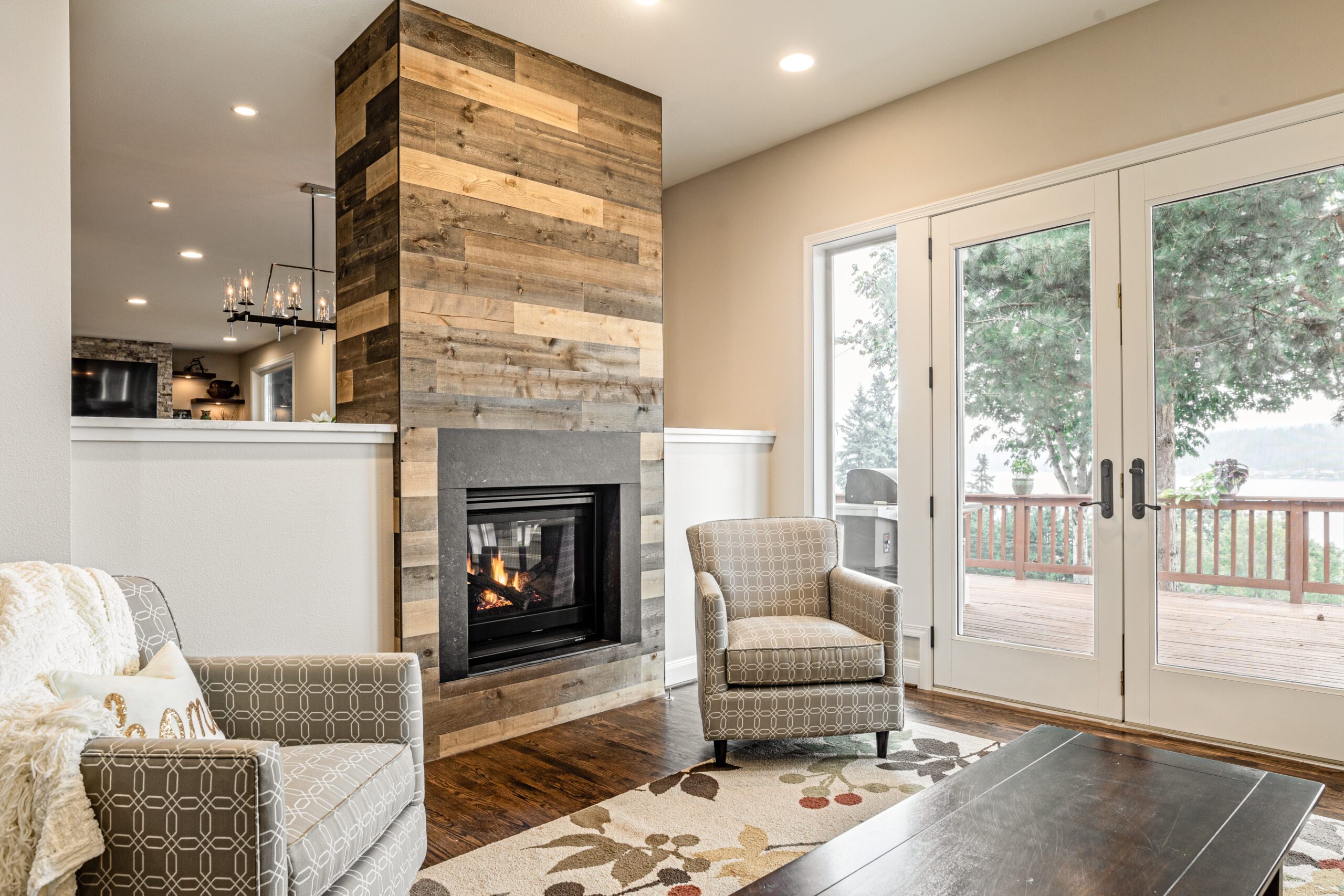
Phase 1 replaced two fireplaces, each with a completely different approach. The family room: linear fireplace with stacked stone and live-edge mantle. The original family room fireplace was a traditional brick surround with a raised hearth platform, built-in cabinetry flanking, and a heavy wood mantle — dated and space-consuming. It was removed entirely, hearth platform and all. In its place: a 48-inch linear gas fireplace set into a full surround of floor-to-ceiling stacked stone in light grey and white ledgestone. A live-edge wood mantle shelf sits above the fireplace, its natural edge and warm tone contrasting with the cool stone. Floating dark wood shelves flank the fireplace on each side, providing display space without the weight of built-in cabinetry. The floor now runs level to the fireplace — the raised platform is gone, and the room reads significantly wider and more open. The double-sided fireplace: dining room and living room. The existing double-sided fireplace between the dining room and living room was removed and replaced with a new unit. The entire fireplace column — floor to ceiling, both faces — was clad in horizontal wood planks in mixed natural tones of grey, brown, and blonde. The fireplace on each side is framed with a metal surround, providing a clean protective transition between the fireplace and the wood cladding. The same treatment wraps both the living room and dining room faces, making the column a unified architectural element visible from either space.

The Entry Stairs

The original staircase had traditional turned wood balusters and a honey oak handrail — heavy and dated relative to the direction the rest of the home was heading. Phase 1 reframed the entry stairs and replaced the wood balusters with satin black iron balusters — slim, straight vertical bars with a clean contemporary profile. The newel posts were replaced with white painted square-cap posts. The handrail was replaced and false treads were restained to match the refinished main floor hardwoods. The upstairs carpet was also replaced during this phase with a neutral warm greige tone.

The Powder Bath

The powder bath received a full refresh. The existing stained wood vanity, countertop, and dated fixtures were replaced entirely. The new vanity is painted navy with shaker-style doors and brass bar pulls — a bold, room-defining choice. The countertop is white with a clean undermount rectangular sink. A brass widespread faucet completes the vanity. The wall behind the vanity is tiled countertop to ceiling in a hexagon mosaic tile of white and soft grey-blue tones — graphic and striking, the room's focal point. Centered on the tile wall hangs a round mirror suspended from a brass post. Two antique brass pendant lights flank the mirror, casting warm light across the mosaic. The original crown molding was retained and repainted. The result is a powder bath that feels like a considered, complete room rather than an afterthought.

The Primary Bath & Closet

The primary suite was one of the most significant transformations in Phase 1 — not just a rebuild, but a complete reconfiguration. The original layout had separate his and hers closets flanking the entry to the bathroom, his and hers vanities across from each other, a massive tub in front of the room's main window, and a shower tucked in a corner. Walls were removed, the toilet was relocated, the shower was moved, and the vanity areas were consolidated. The only element that stayed in its original location was the tub — and even that was replaced. The result is a suite that functions as one connected, free-flowing space with in-floor radiant heat throughout. The tub: A freestanding oval soaking tub now sits centered under the room's arched window — a pairing that feels intentional, the arch framing the tub like a picture. Three recessed display niches in the wall beside the tub give the homeowners a place for art, photos, or personal objects. A floor-mount tub filler in matte black stands beside the tub. The shower: A large walk-in shower with a frameless glass enclosure and matte black hinges. The shower walls are large-format white tile. The shower floor is mosaic penny tile. A wall-mounted shower head — positioned and angled overhead to function as a rain shower experience — pairs with wall-mounted controls and a hand shower, all in matte black. A recessed niche inside the shower provides storage. The vaulted ceiling above adds volume to the space. The vanity: Removing the walls to the original closets allowed the two separate vanity areas to be brought together into one long, unified vanity wall. White shaker-style cabinetry with matte black bar pulls and knobs runs the full length. The countertop is dark charcoal stone with visible veining, with two undermount rectangular sinks and matte black widespread faucets. Two separate wood-framed mirrors hang above — one per sink — with cylinder wall sconces in matte black flanking each. The open closet beyond is visible in the mirrors, reinforcing how connected the suite feels. The closet: With the walls removed, the closet became more accessible. A full custom built-in system in white cabinetry with frosted glass upper cabinet doors and matte black hardware lines the walls — hanging rods, open shelving, and upper storage throughout. At the center of the room sits a double-sided island with drawers on both faces, providing flexible storage for both homeowners. The herringbone tile floor runs continuously from the bath through the closet, completing the suite.

Hardwood Refinishing & Floating Shelves

The hardwood floors throughout the main level were sanded, stained, and refinished. Floating shelves were added flanking the family room fireplace, in a dark wood tone that coordinates with the live-edge mantle.
Technical Highlight

A Complete Reconfiguration, Not Just a Rebuild

In the primary suite, walls were removed, the toilet was relocated, the shower was moved, and the two separate vanity areas were consolidated into one long, unified vanity wall. The only element that stayed in its original location was the tub — and even that was replaced. The herringbone tile floor runs continuously from the bath through the closet, and in-floor radiant heat runs throughout the suite.
Phase Two

Upstairs full bath: gutted and rebuilt

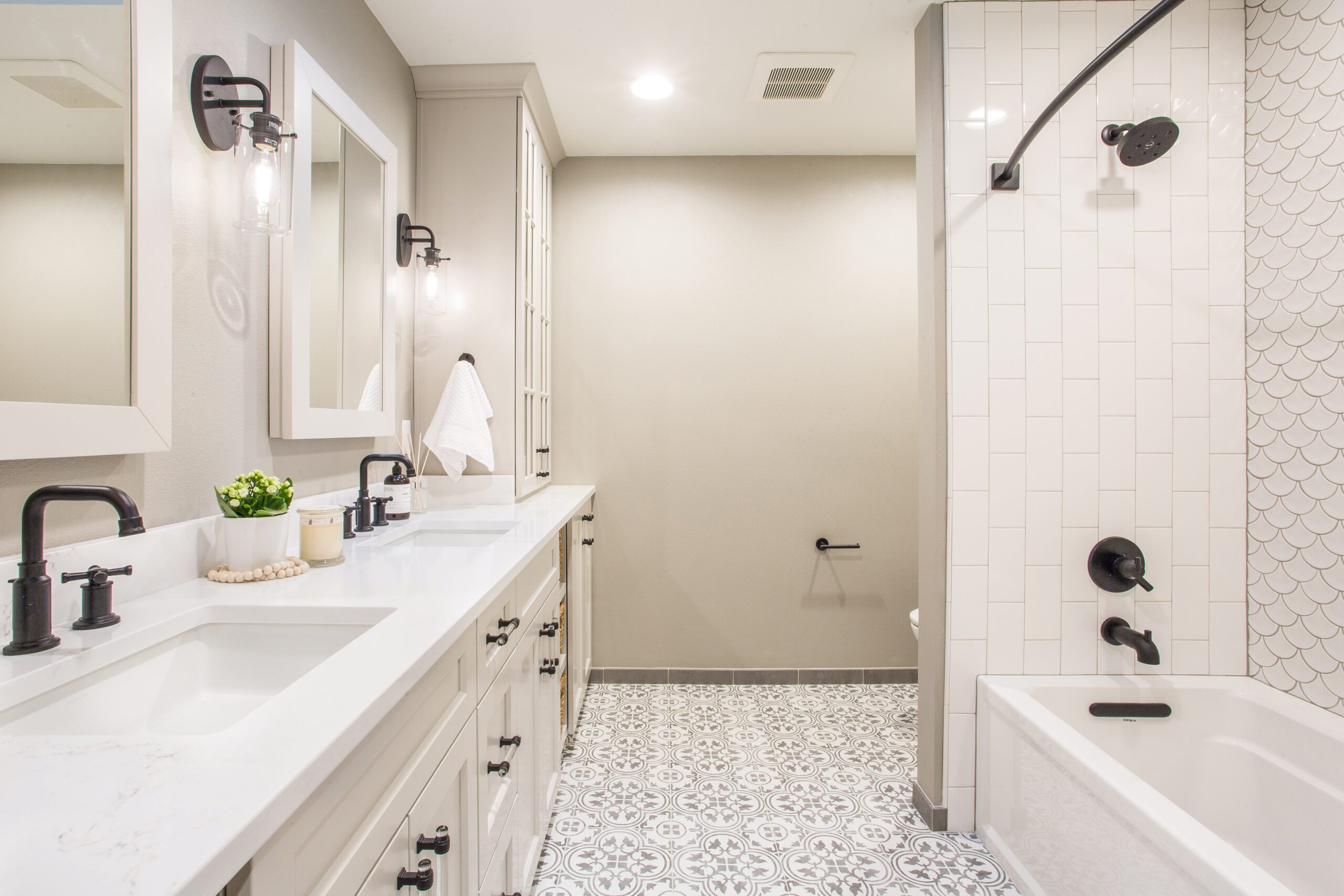
Phase 2 came just four months after Phase 1. The scope was a complete gut of the upstairs full bathroom — a room that had bold plaid wallpaper, dark green tile countertops, and dated oak cabinetry. The vanity: A long double vanity in white painted shaker-style cabinetry replaces the original. The countertop is Misterio by Pental — white with soft grey veining — with two undermount rectangular sinks and matte black widespread faucets. Open cubby sections in the lower cabinetry provide accessible storage. At the end of the vanity, a built-in display cabinet with glass-front upper doors and open shelving ties into the vanity cabinetry and adds character to the room. Two white framed medicine cabinet style mirrors hang above, providing additional storage, with industrial-style matte black sconces providing warm light. A skylight above floods the room with natural light. The floor: New Memoir tile in the Petal Grey pattern — a decorative mosaic with a scrollwork medallion design in white and grey — covers the entire floor. It's a distinctive choice that gives the room personality without competing with the vanity wall. The tub/shower: The tub-shower combo was rebuilt with a new tub. The back wall above the tub is tiled floor to ceiling in MSI White Glossy Fish Scale Pattern Mosaic — a scallop-shaped tile in glossy white that catches light across its curved surface. A recessed niche inside provides shower storage. Fixtures throughout are matte black — shower head, tub spout, controls, and a curved shower curtain rod.
Phase Three

The kitchen and upstairs laundry

Phase 3 arrived three years after Phase 2. The scope was focused: kitchen countertops, backsplash, sink and faucet, cabinet hardware, and the laundry room.

The Kitchen

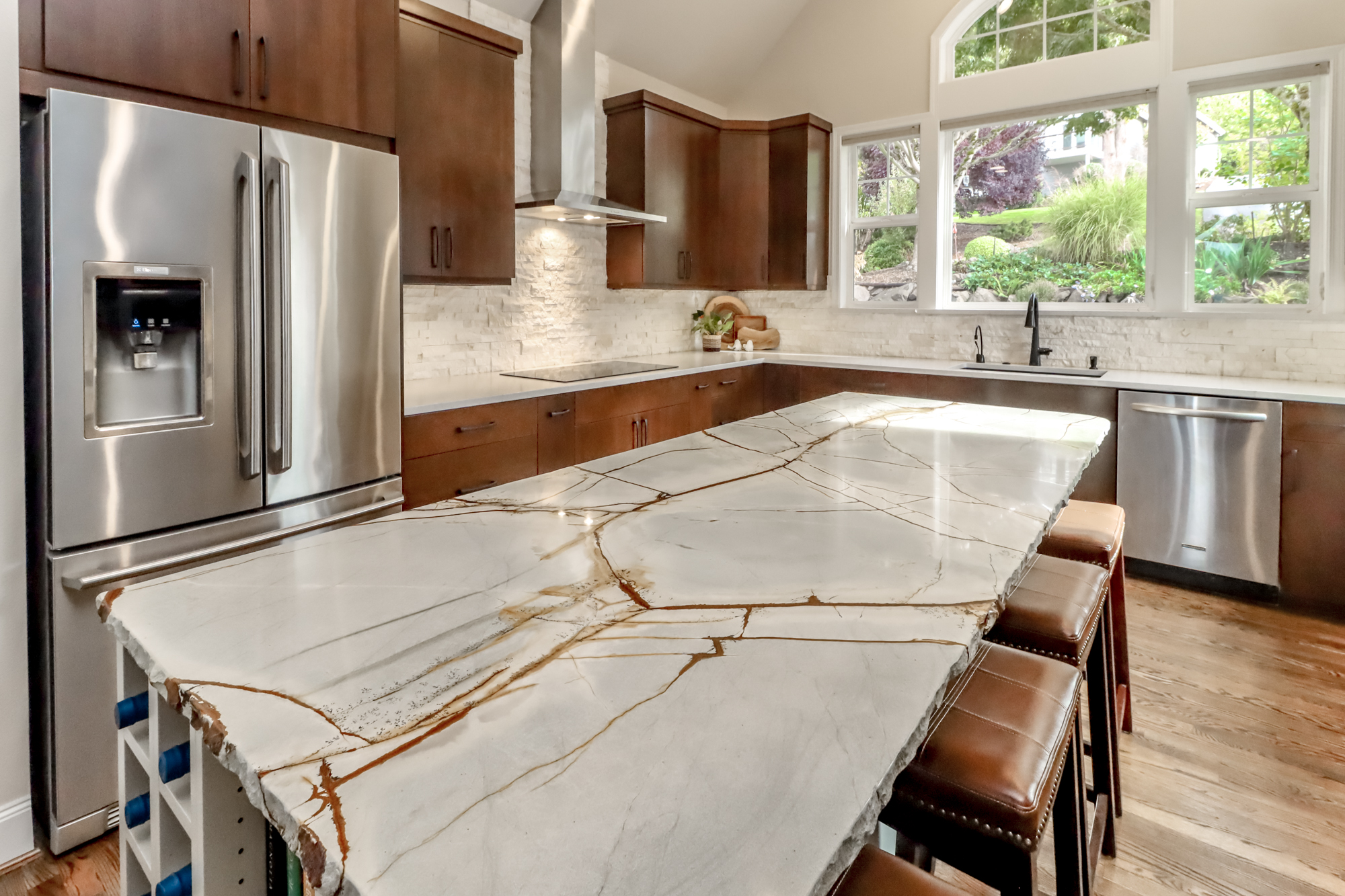
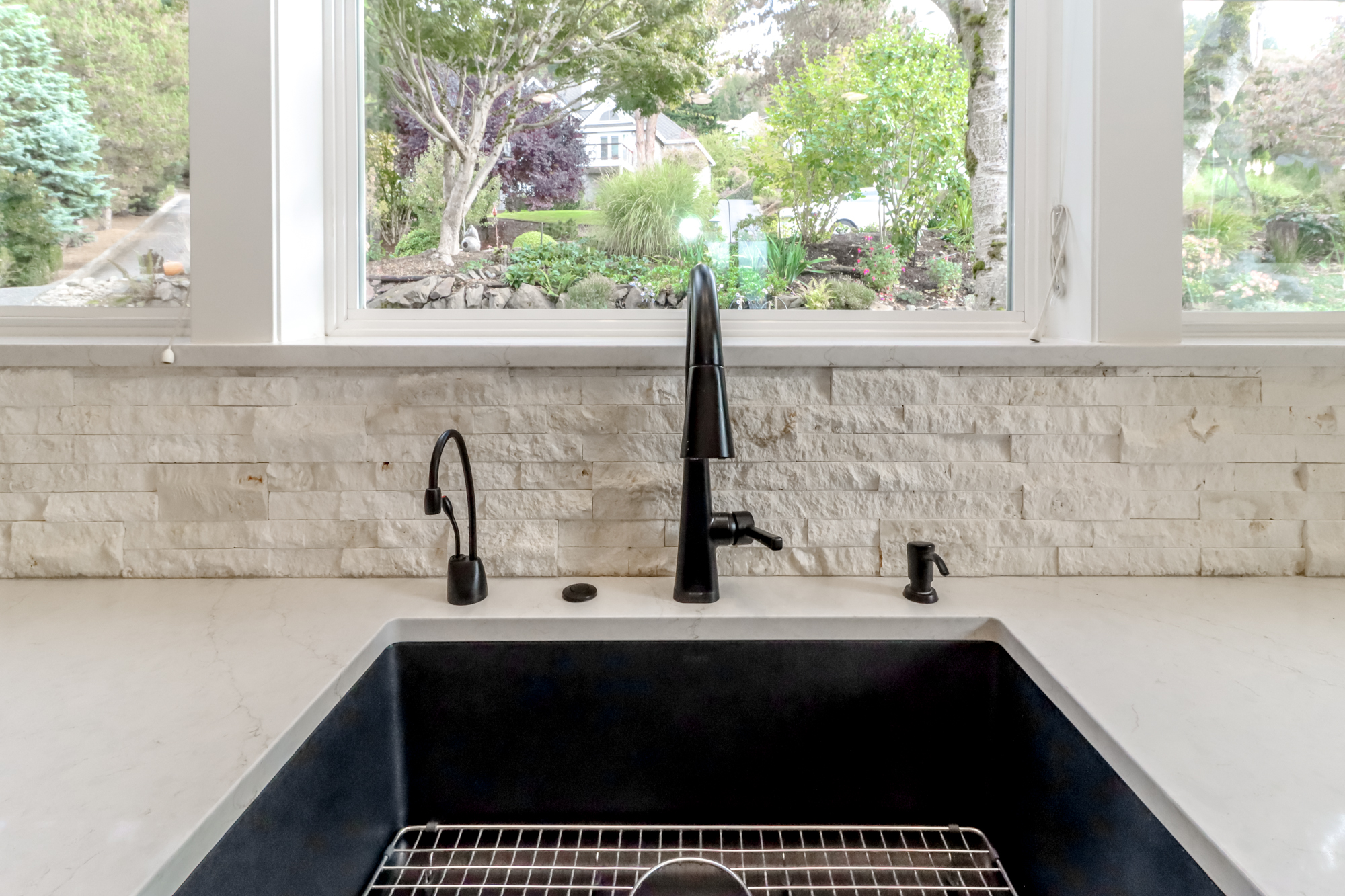
The kitchen's dark espresso cabinetry, stainless appliances, and vaulted ceiling with arched window were all in place. What Phase 3 changed was the surface language — and the result transformed the room. The island: Roma Blue quartzite. The island countertop is Roma Blue quartzite from Bedrosians — a stone whose name belies its appearance. Roma Blue reads as white and cream with bold rust and amber veining that cuts dramatically across the surface. The edge is hand-chiseled: rather than a machine-polished profile, the edge of the stone is deliberately broken and textured by hand, exposing the raw quartzite crystal structure. The top surface is polished; the edge is organic and rough. The contrast between the two finishes — and between the Roma Blue island and the quieter perimeter — gives the kitchen dimension and a clear focal point. No two slabs of Roma Blue are alike, and this one is a statement. The perimeter: Calacatta Karmelo. The perimeter countertops and window ledges are Calacatta Karmelo from MSI — white with soft grey veining, lighter and more restrained than the Roma Blue. The deliberate contrast between the two stones gives the kitchen depth without chaos. The island commands attention; the perimeter supports it. The backsplash. The stacked stone backsplash matches the stacked stone installed on the family room fireplace surround in Phase 1 — the same warm natural tone, the same horizontal layering. Under-cabinet lighting illuminates the texture. The connection between the kitchen and family room is now material as well as spatial. Sink, faucet, and hardware. The sink and faucet were replaced — matte black faucet at the sink, tying into the matte black hardware throughout the home. All cabinet hardware was removed and powder coated matte black. The existing hardware had the right profile and proportion for the doors. The problem was the finish. Powder coating modernized the entire kitchen without replacing a single knob or pull.
Design Detail

Hand-Chiseled Edge on Roma Blue

The Roma Blue island features a hand-chiseled edge — a profile where the edge of the stone is deliberately broken and textured by hand rather than machine-polished, exposing the raw quartzite crystal structure. The top surface is polished; the edge is organic and rough, catching light differently at every angle in a way a straight polished edge can't achieve. Paired with the quieter Calacatta Karmelo perimeter, the contrast between the two stones gives the kitchen dimension and a clear focal point.

Laundry Room

Phase 3 also updated the laundry room. The countertop was replaced with Misterio by Pental — the same material used in the upstairs bath — along with a new matte black undermount utility sink and matte black pull-down faucet. New floor tile was installed. The existing cabinetry was left in place.
The Result

Three phases, one home

Phase 1 opened the main floor, replaced two fireplaces, completely reconfigured and rebuilt the primary bath and closet suite, refreshed the powder bath, reframed the entry stairs, and refinished the hardwoods. Phase 2 gutted and rebuilt the upstairs full bath with new cabinetry, Misterio countertops, fish scale tile, and Memoir floors. Phase 3 brought the kitchen to life with a Roma Blue quartzite island, Calacatta Karmelo perimeter, stacked stone backsplash, and powder coated hardware — and updated the upstairs laundry to match.
The homeowners didn't remodel once. They kept coming back. That's the highest compliment a homeowner can pay a builder.
Each phase had context from the one before. The stacked stone in the Phase 3 kitchen connects to the family room fireplace from Phase 1. The Misterio countertop in the Phase 3 laundry matches the Phase 2 bath. The matte black hardware that runs through the kitchen started in the primary bath. The homeowners didn't remodel once. They kept coming back.