The Eastside Homeowner’s Guide to Choosing a Whole-Home Remodeler
A candid, experience-driven guide to selecting the right builder for one of the most significant investments you’ll make in your home, and how to protect your project from the mistakes most homeowners only recognize in hindsight.
Every homeowner on the Eastside has heard the story. A friend, a neighbor, maybe a relative. Someone who started a whole-home remodel with a trusted contractor and ended it eighteen months later, $80,000 over budget, wishing they’d never begun. The details vary. The pattern doesn’t.
After three decades of remodeling homes in Bellevue, Issaquah, Sammamish, and Redmond, and eight Best of Houzz awards for both design and service, we’ve come to believe something that isn’t widely said in our industry: the single biggest predictor of a successful whole-home remodel isn’t the design, the finishes, or even the budget. It’s the contractor you choose on day one.
This guide is our honest attempt to help Eastside homeowners make that choice well. It’s the conversation we wish every client could have before signing their first contract with any builder, ours included.
What a whole-home remodel actually involves
Before you interview a single contractor, it’s worth understanding what you’re committing to. A whole-home remodel is not a kitchen project with more rooms attached. It’s a fundamentally different undertaking: one that changes how your home functions, where its structural loads live, and how every mechanical system interacts with every other.
On the Eastside, a typical whole-home remodel includes some combination of the following:
- Structural work. Removing or modifying load-bearing walls, adding beams, reconfiguring rooflines, sometimes raising ceilings or adding a story.
- Mechanical system upgrades. HVAC redesign, electrical panel replacement, plumbing reroutes, often a full switch from older fuel sources to electric or heat-pump systems.
- Envelope improvements. Insulation, windows, siding, roofing, waterproofing. In our climate, these decisions have a decade-long impact.
- Finish-level renovation. Cabinetry, countertops, flooring, tile, paint, fixtures, lighting, hardware. The visible work that most homeowners imagine when they picture a remodel.
- Permits and inspections. King County, Bellevue, Redmond, Issaquah, and Sammamish each have distinct permit processes, inspection schedules, and code requirements.
Coordinating these moving parts is the actual job of a whole-home remodeler. The finishes are the easy part. The discipline of running a project where framing, electrical, plumbing, HVAC, insulation, drywall, cabinetry, tile, and finish carpentry all have to happen in the right sequence, on the right day, without stepping on each other’s work. That’s where the difference between a good remodel and a painful one actually lives.
A typical Eastside whole-home project runs four to eight months from demo to final walkthrough, and involves somewhere between a dozen and thirty subcontractors touching the house over that time. The contractor’s most important job isn’t any single trade. It’s the choreography.
The five questions that matter most
Most homeowners interview three or four contractors and ask more or less the same questions: How much? How long? Have you done this before? Those questions matter, but they’re not the ones that separate a contractor who will protect your project from one who will expose it. These five will.
1. What does your pre-construction process look like?
This is the single most revealing question you can ask. A contractor who answers, “We’ll come out, take some measurements, and get you a bid,” is telling you something important: they’re going to start your project with incomplete information and solve problems in real time, at your expense, after the walls are open.
The contractors worth hiring have a structured pre-construction phase that happens before a single hammer swings. On our projects, that includes a detailed site survey, constructability review, systems assessment, permit analysis, a realistic budget built from actual subcontractor quotes, and a written timeline that accounts for the specific quirks of your house. This work takes weeks. It prevents months of problems.
2. Can I speak with three clients whose projects are at least a year old?
Anyone can produce a glowing reference from a project that just finished. A year later, the truth emerges about warranty responsiveness, about how finishes have held up, about whether the contractor actually returned calls after the final check cleared. Ask for references from projects that are at least twelve months out, and actually call them. If a contractor can’t or won’t produce that list, you have your answer.
3. Who will be on-site every day, and what is their decision-making authority?
On a whole-home remodel, dozens of small decisions get made every week that affect your finished home. Who is your contractor’s representative on those decisions? Is it the owner, who visits twice a week? A project manager, who is on-site daily? A lead carpenter, whose authority ends at the tools they hold?
The right answer depends on the company’s structure, but the wrong answer is always the same: “We’ll figure it out as we go.” You want clarity, and you want to meet that person before you sign anything.
4. How do you handle change orders, and how often do they happen on your projects?
Change orders are the most common source of homeowner anger during a remodel. Two answers should concern you: a contractor who promises “there won’t be any change orders” (impossible on a project of this scale) and a contractor who shrugs and says “it depends.”
The right answer is specific. It’s a written change-order process that explains how they’re documented, how they’re priced, when they require your approval, and what the contractor does when a change is their own fault. A builder who willingly absorbs the cost of their own mistakes is signaling integrity that will reveal itself in every other part of the project.
5. What happens if something goes wrong a year after the project is done?
Every whole-home remodel will have at least one issue that surfaces months after completion. A cabinet door that settles. A tile that cracks. A finish that doesn’t age the way anyone expected. The question isn’t whether it will happen. It’s what the contractor does when it does.
A contractor with a real warranty process will be able to describe it in detail: the length of the workmanship warranty, what’s covered, who to call, typical response time. A contractor who dodges this question is telling you their relationship with you ends at final payment.
How to read between the lines of a bid
Once you have two or three bids in hand, the comparison game begins, and it’s easier to get this wrong than right. Homeowners often assume the lowest bid represents the best value, or the highest bid represents the best quality. Neither is reliably true.
What matters is how the bids are structured. A trustworthy bid is itemized, specific, and clearly scopes both what is and what is not included. Here’s what to look for:
- Line-item pricing, not bundled lump sums. If “kitchen remodel” is a single line at $85,000, you have no way to compare it meaningfully to another contractor’s bid. You want to see cabinetry, countertops, appliances, electrical, plumbing, flooring, tile, and finish carpentry priced separately.
- Named subcontractors where possible. Reputable contractors know their subs and are willing to name them. If a bid refers only to generic trades without specific companies, ask why.
- Explicit allowances for finish selections. Countertops, tile, fixtures, and appliances are often priced as allowances, a dollar amount the contractor has budgeted for a category. Allowances that are clearly too low are how projects balloon. A good contractor will size allowances realistically for the quality level you’ve described.
- A written scope of exclusions. Equally important is what isn’t in the bid. Landscape restoration? Appliance installation by the manufacturer? Permit fees? Unclear exclusions are how $65,000 overruns start.
- Payment schedule tied to milestones, not calendar dates. A responsible payment schedule ties draws to work completed (framing complete, rough mechanical passed, cabinetry installed) rather than to arbitrary weekly or monthly intervals.
Why the cheapest option is almost never the cheapest.
In thirty years of building on the Eastside, we’ve seen the pattern hundreds of times. A homeowner takes the lowest bid, the project starts, and within three months the change orders begin. By completion, the “cheap” project has matched or exceeded the middle bid. Only now it’s also late, the trades are exhausted, and the relationship is adversarial.
A realistic bid isn’t an attempt to extract more money. It’s an attempt to tell you the truth about what your project will cost. That’s a feature, not a flaw.
Lake Sammamish View: one home, three projects, one builder.
The clearest proof of choosing the right contractor isn’t one dramatic remodel. It’s a homeowner who keeps coming back.
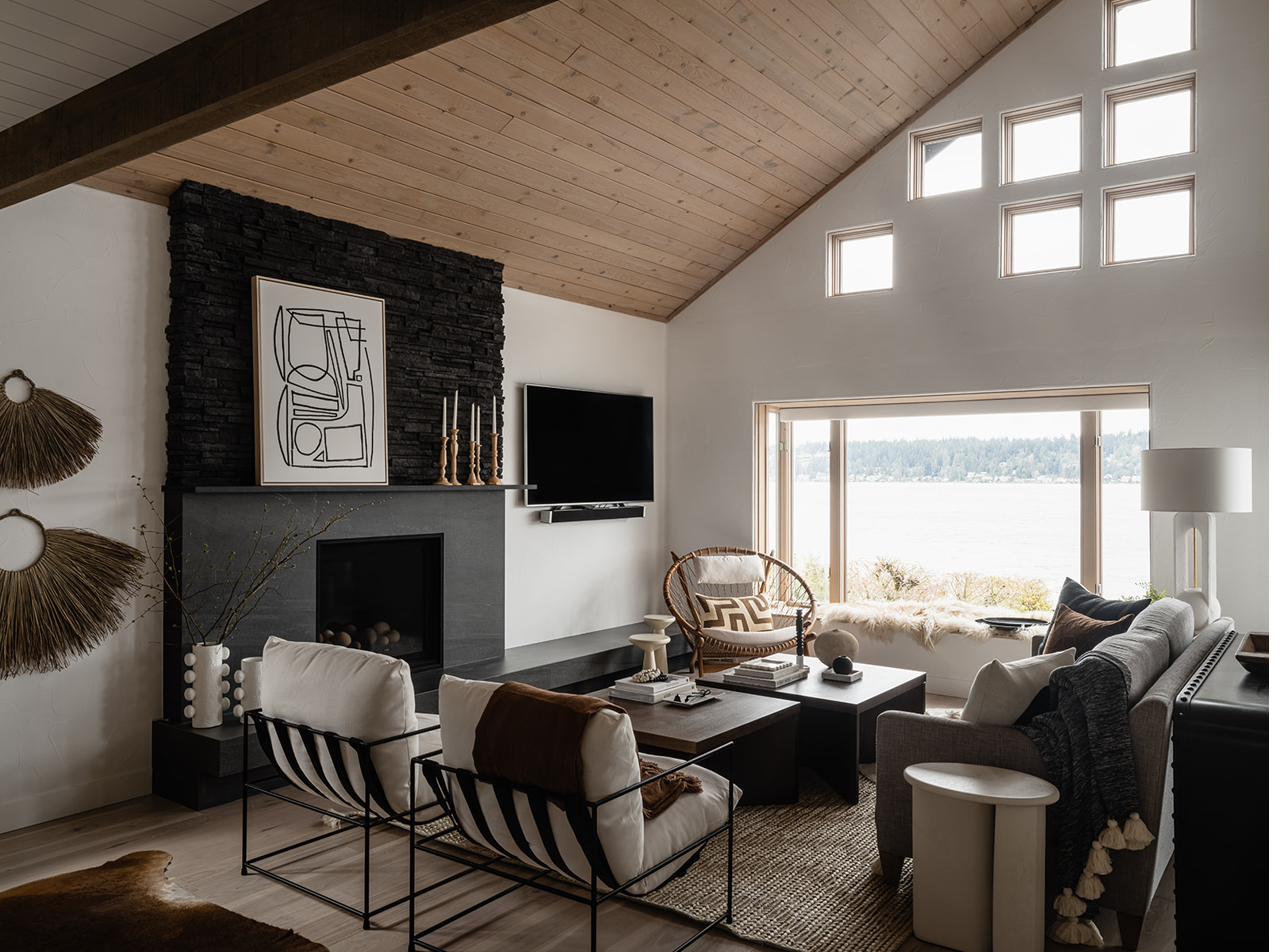
A Sammamish couple first came to Schock for a primary suite and a main-floor reconfiguration. The old bookcase wall and dated finishes came out, and the main floor opened into one continuous space with Lake Sammamish visible from nearly every angle. Four months later they were back, this time for a complete gut of the upstairs bathroom. Three years after that, they returned a third time for the kitchen: a Roma Blue quartzite island with a hand-chiseled live edge, a stacked-stone backsplash that ties back to the family-room fireplace from the very first phase, and every piece of hardware powder-coated to match the home’s evolving language.
Three engagements. Three years. One builder, because each phase carried the trust and the context of the one before it.
That’s the whole point of choosing well on day one. When the contractor relationship is right, a remodel doesn’t end at the final walkthrough. It becomes a long-term partnership that makes every future project faster, smoother, and more cohesive. Read the full Lake Sammamish View case study →
The red flags most homeowners miss
Some warning signs are obvious: a contractor who can’t produce a license number, won’t share references, or insists on cash payments. Those you’ll spot easily. The more dangerous ones are subtler, and they often surface only after you’ve signed.
The contractor who never says no
A builder who agrees with everything you want is not protecting you. They’re protecting the sale. Every experienced contractor has opinions about what will work, what will date badly, what will exceed the budget you’ve described, and what simply won’t function. A contractor who pushes back thoughtfully on one or two of your ideas is demonstrating judgment. One who nods through every request is planning to solve the hard conversations later, after the contract is signed.
The bid that arrives too quickly
A serious whole-home bid takes time. Site visits, subcontractor outreach, permit research, material pricing, and a real look at the existing structure’s condition. If a contractor produces a whole-home bid within a week of your first meeting, they are either (a) using templated numbers that will change dramatically once the work starts or (b) guessing. Both are expensive in different ways.
The absent owner
On smaller companies, the owner typically plays a visible role in the sales process and then disappears into the background once the project begins. On larger firms, a project manager or client liaison takes that role. Either structure can work. But when the transition is unclear, projects drift. Ask directly, before signing: “After we sign, who is my primary point of contact, and how often will we speak?”
The website that’s all renderings
A contractor whose portfolio is heavy on 3D renderings and light on actual completed project photography is telling you something. Renderings are aspirational. Photographs are evidence. Any established contractor should be able to show you dozens of completed projects, preferably photographed professionally at the walkthrough and again a year later. If they can’t, ask why.
Pressure to decide
A trustworthy contractor wants you to interview others, get second bids, and take the time you need. Time pressure, such as “I can only hold this pricing for two weeks,” or “my schedule fills up fast,” is the oldest sales tactic there is, and it has no place in a six-figure home-improvement decision. The contractors who will respect your project are the ones who respect the decision that precedes it.

Credentials that actually matter
Most homeowners know to check that a contractor is licensed, bonded, and insured. Those are table stakes, the minimum required to legally operate. They tell you nothing about whether the contractor is any good. For that, look deeper.
- Industry association membership. The National Association of Home Builders (NAHB), the Master Builders Association of King and Snohomish Counties (MBA), and the Building Industry Association of Washington (BIAW) are the three most meaningful memberships for a Pacific Northwest remodeler. Membership signals a contractor engaged with the industry, accountable to peer standards, and subject to professional ethics oversight.
- Houzz award history. Houzz’s Best of Houzz awards are given in two categories: Design and Service. The Design award recognizes project quality. The Service award reflects client satisfaction scores collected throughout the year. Winning either once is meaningful. Winning both repeatedly is rare. Fewer than three percent of remodelers on Houzz hold multi-year awards in both categories.
- Project longevity in a single market. A contractor who has built a decade or more of work in the same geographic area has something to lose from a bad outcome. Their reputation is a local asset. A contractor who has moved between markets, or whose company is newly rebranded, is worth extra scrutiny.
- Trade relationships. Ask which electricians, plumbers, tile setters, and finish carpenters the contractor uses, and how long they’ve worked together. Established trade relationships mean the contractor has vetted these crews over dozens of projects. New or shifting trade lineups mean you’re paying for their learning curve.
The conversation to have before you interview anyone
Most homeowners start the contractor search before they’ve finished a more important conversation: the one between themselves and their spouse, or their family, or whoever will live in the finished home. The best time to have this conversation is before the first contractor walks through the door.
A few questions to work through beforehand:
- What is the actual outcome we want? Not the finishes. The outcome. A kitchen that makes cooking easier? A primary suite that feels like a private retreat? A main floor that finally captures our view? Being able to state the outcome cleanly helps every subsequent decision stay aligned with it.
- What is the realistic budget? The one you’d actually spend, including a contingency of fifteen to twenty percent for the discoveries every remodel eventually makes. Homeowners who quote their “budget” as their absolute ceiling often end up wishing they’d budgeted higher and gotten what they really wanted.
- What is our decision-making process? On a whole-home remodel, decisions come fast and often need a same-day answer. Who decides? How do you handle disagreements between spouses? Projects run more smoothly when this is settled before it’s tested.
- How long can we live in the disruption? Some homeowners can comfortably stay in a home during an active remodel. Others cannot. Neither is wrong. But the honest answer shapes scheduling, phasing, and sometimes the scope itself.
A contractor can help you refine these answers, but they can’t provide them for you. Walking in with clarity on these four questions will make every subsequent conversation more productive, and will reveal quickly which contractors actually listen.
Eight awards. Two categories. One standard.
Schock Construction has been awarded Best of Houzz for both Design and Service eight times since 2016, a distinction fewer than three percent of professionals on the platform hold.



Questions Eastside homeowners actually ask us.
Considering a remodel? Let’s have the right conversation first.
Every Schock project begins with a candid discovery call. No pressure, no pitch. We’ll listen to what you’re trying to accomplish, and give you an honest assessment of whether we’re the right team for it. If we’re not, we’ll tell you who might be.
Request a Discovery Call